
Wildlife in Bandhavgarh National Park, India
Bandhavgarh Wildlife Sanctuary
Probably the most visited park in India, Bandhavgarh was also a hunting reserve previously just like other national parks in India. The reserve was declared a wildlife sanctuary in 1958 and came under the "Project Tiger" as a tiger reserve in 1979.
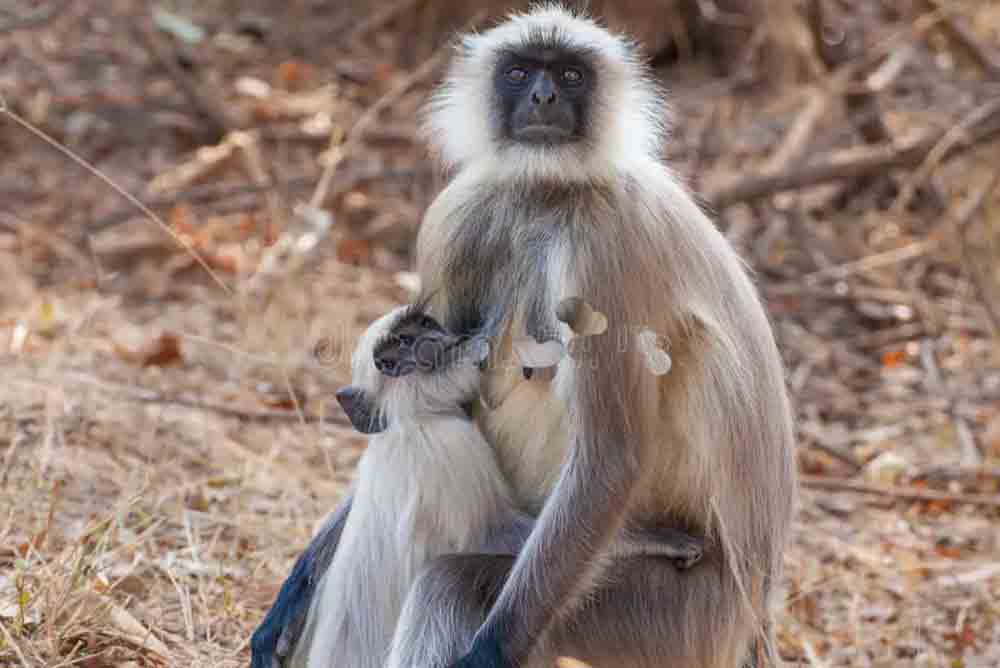
Hanuman Langur - Bandhavgarh National Park, India
The word "Langur": "Langur" is a Hindi word, possibly from Sanskrit, for "tailed." "Hanuman" is a Sanskrit word for "having jaws."
Location: India and Pakistan.
Habitat: Arboreal and terrestrial. Forests, but also in open terrain.
Description: The langur has a slender body and arms, and long fingers and toes except for the small but opposable thumbs. There are various subspecies which differ in coat color, which is usually gray or brown, and in the varying position of the tufts of hair around the face. The face and hands are black. Length of head and body 17 to 32 in, tail longer at 21 to 42 in, weight 20 to 44 lbs, female about 70% of male weight.
Behavior: The langur is distinguished from the other subfamily of Old World monkeys by their leaf-eating specializations, such as complex stomachs and better developed cross ridges on the teeth. It feeds on young leaves, fruit, and flowers, and is the most terrestrial of these monkeys, descending to the ground to drink, gather food, or move from one area to another. It lives in socially organized groups, each with its own territory, headed by one or more males. In one-male groups, takeovers by a new male occur every few years, sometimes resulting in the death of infants.
Reproduction: Gestation lasts about 200 days. All the females in the group take part in the care of the single newborn young.